How Much Does AI Integration Cost for a Small Business?
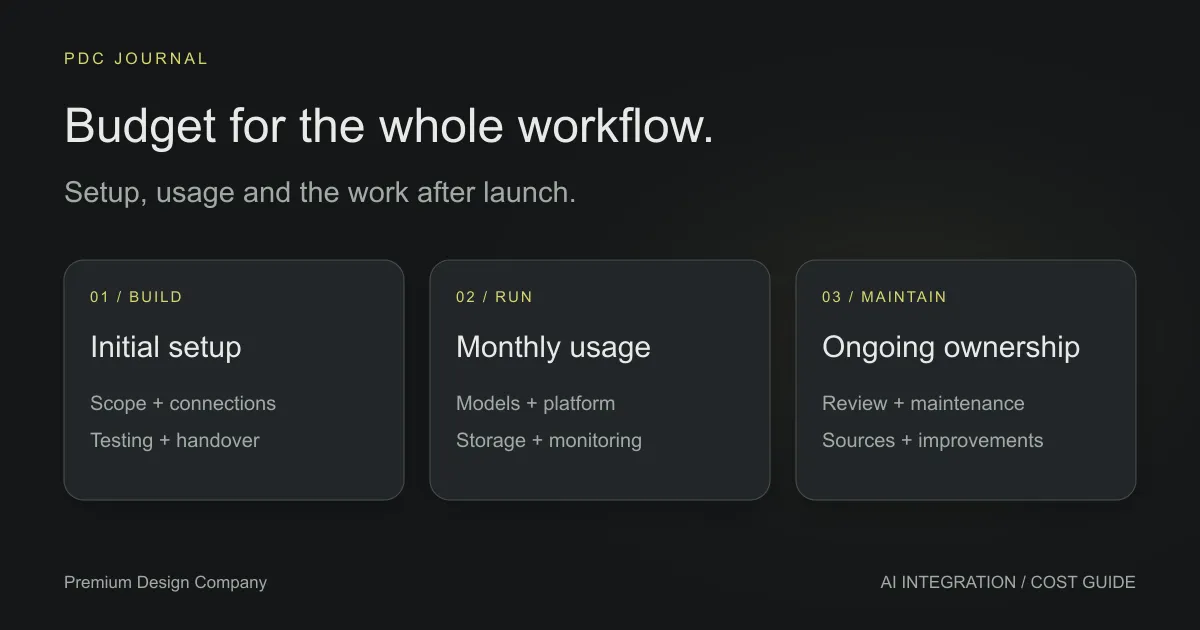
AI integration costs have three parts: the initial build, recurring software and usage bills, and the work required to keep the system useful. A model’s advertised price covers only part of that budget. Connecting your order system, preparing reliable information and giving your team a way to review mistakes are separate tasks.
For a small business, the useful starting question is: “What would it cost to improve this one workflow?” A support assistant that drafts replies from approved documents needs a different scope from an agent that checks orders, updates customer records and sends messages.
This guide shows how to budget for that difference. The worked example below uses a hypothetical $6,000 implementation budget, plus separately calculated operating costs. It is a planning exercise, not a market average, a PDC quote or a record of a client project. Replace its assumptions with your team’s actual scope and supplier rates.
Vendor prices checked on 15 October 2026. Dollar amounts are USD; the n8n example is in EUR. Check current rates, taxes and billing terms before purchasing.
Choose the kind of integration first
There are three useful starting points. Each puts a different amount of responsibility on your team.
| Approach | What you are buying or building | What to include in the budget |
|---|---|---|
| An AI feature in software you already use | A feature configured inside an existing helpdesk, CRM or document tool | Eligible plan, usage charges, configuration, source preparation and staff training |
| A connected workflow | A defined process linking a few systems, with AI used for a specific step | Workflow platform, model usage, connectors, implementation, testing and maintenance |
| A custom assistant or agent | A dedicated interface or service with business-specific permissions and actions | Discovery, interface design, software development, access controls, evaluation, hosting and ongoing ownership |
Start by checking whether your existing software can do the job. If it already provides the right permissions, handoff and reporting, configuring it may avoid a separate application. Verify which features are included in your plan rather than assuming that every AI capability comes with the base subscription.
A connected workflow can make sense when the steps are clear but span several tools. Custom development becomes worth discussing when the workflow needs an interface, access rules or behaviour that existing tools cannot provide. The decision should follow the work your team needs to complete.
What the initial build pays for
A useful estimate explains the deliverables behind the total. Ask for these areas to be visible, even if a supplier groups several together.
Workflow discovery. Someone needs to map the trigger, the information required, the result and the situations that need a person. Our AI integration brief template helps you prepare this before asking for an estimate.
Information preparation. Approved documents may need cleaning, deduplication or clearer ownership. Two contradictory refund policies create a business decision that software cannot settle for you. Include time from the person who maintains those policies.
Connections and permissions. Reading a public FAQ is different from accessing private order records. Each connection needs an agreed way to authenticate, select the right records and handle unavailable systems.
The review experience. Staff may need to inspect a source, edit a draft, approve an action or take over a request. Include that experience in the scope. Our article on states and feedback in SaaS interfaces explains why visible progress and clear outcomes matter.
Testing and handover. A working demonstration does not establish that the integration handles your real requests. Budget for representative examples, failed lookups, missing information, restricted actions and instructions for pausing the system.
A worked setup budget for one support workflow
Imagine a small online shop that wants to prepare delivery-status replies. The first version reads approved delivery guidance, looks up an order through an existing API and saves a draft for a support colleague to approve. It cannot issue refunds or send messages on its own.
For this example, assume the helpdesk already supports saving drafts, the order API is available, and the shop has an owner for its support documents. A new customer portal, a difficult legacy connection or substantial document cleanup would change the scope.
The following hours and $75 hourly rate are invented inputs for the calculation, not PDC pricing or promised delivery effort.
| Work item | Assumed hours | Example cost |
|---|---|---|
| Map workflow and acceptance criteria | 8 | $600 |
| Prepare and organise approved information | 12 | $900 |
| Connect helpdesk and order lookup | 24 | $1,800 |
| Configure drafting and human review | 12 | $900 |
| Test ordinary requests and failure cases | 16 | $1,200 |
| Document, train and hand over | 8 | $600 |
| Total implementation | 80 | $6,000 |
This table gives you something to question. Which connection is already available? Who prepares the documents? Does the testing include a failed lookup and an instruction hidden in a customer message? Is staff training included?
The total excludes software subscriptions, usage, taxes, the shop’s internal staff time and future changes. It also excludes a contingency allowance. Ask the supplier to identify unresolved dependencies and price or cap the investigation needed to resolve them.
Do not turn 80 hours into a calendar promise. Access approvals, document reviews and staff availability can affect elapsed time independently of implementation effort.
Calculate monthly running costs separately
Use this structure for your operating budget:
Monthly cash cost =
  model and tool usage
  + workflow platform or application hosting
  + storage and monitoring
  + channel or helpdesk charges
  + external maintenance and support

Monthly internal effort =
  reviewing outputs
  + maintaining source information
  + handling exceptions and checking performance
Keep internal effort visible even when it does not appear as a new invoice. A workflow that requires lengthy review may have a low software bill and still offer little practical value.
Model usage: a small calculation
OpenAI lists GPT-5.4 mini standard text pricing at $0.75 per million input tokens and $4.50 per million output tokens. A token is a unit of text processed by the model; input is what it receives and output is what it generates. This is a pricing example, not a recommendation that the model suits your workflow. Source: OpenAI model documentation.
Suppose the shop processes 2,000 requests each month. Assume each request uses a total of 3,000 billable input tokens and 500 billable output tokens across its model calls:
| Calculation | Example monthly cost |
|---|---|
| 2,000 × 3,000 input tokens = 6 million; 6 × $0.75 | $4.50 |
| 2,000 × 500 output tokens = 1 million; 1 × $4.50 | $4.50 |
| Model tokens under these assumptions | $9.00 |
That is only the token component. The calculation assumes no caching discount and excludes separately billed tools, document indexing, storage, retries and other services. Include any billable reasoning tokens in measured output usage. If a request makes several calls, count the tokens across all of them.
Measure representative requests during the pilot. Long conversation histories, large retrieved documents and repeated attempts can change the bill even when the number of customers stays the same.
Workflow software: check the billing unit
For comparison, n8n lists its hosted Starter plan at €20 per month, billed annually, with 2,500 workflow executions per month. Its pricing is based on executions. Source: n8n pricing.
This is a separate platform charge. Whether a particular plan fits depends on the actual workflow and required features. A customer conversation can trigger several executions, and scheduled checks can consume capacity without a new customer request. Confirm how your proposed design is counted.
Keep the EUR subscription separate from the USD model example until you choose an exchange-rate assumption. Also distinguish a monthly equivalent from an annual payment commitment when planning cash flow.
Maintenance and review: name the owner
Ask who investigates failed requests, updates connections and checks behaviour after a source or model changes. Agree which support is included, what triggers additional fees and who can pause the integration.
A simple way to expose this cost is to allocate hours explicitly. If a hypothetical external maintenance allowance is four hours a month at the same illustrative $75 rate, that is $300 a month. It is a placeholder to replace with an agreement, not a required maintenance package.
Under those assumptions, the example has $309 a month in model tokens and external maintenance, plus the €20 monthly platform equivalent. Hosting outside that platform, other tools, channel fees, taxes and internal review time still need their own entries. A first-year worksheet would therefore begin with $9,708 plus €240, before those additional items: $6,000 setup + 12 × $309, alongside the annual platform amount.
What makes an AI project more expensive?
The number of connected systems matters, but the permissions and exceptions inside each connection matter too. Fetching an order status is a smaller responsibility than changing the order and notifying the customer.
Common scope changes include:
- Unprepared information: scanned files, inconsistent policies or records without a clear owner.
- Difficult connections: missing APIs, restricted access or systems that need custom middleware.
- Actions with consequences: sending messages, changing records or triggering payments requires additional controls and verification.
- More audiences: different customer accounts, staff roles or languages need relevant acceptance examples.
- Higher operating requirements: stricter availability, response times or support arrangements need to be priced explicitly.
- A dedicated interface: a new dashboard or customer portal adds design and development work.
Ask what happens to the estimate when one of these changes. “Connect one more tool” can mean a small configuration task or a substantial new workflow.
Decide whether the pilot is worth paying for
Record a baseline before launch. How many eligible requests arrive, how long do they take, and how much checking will still be necessary?
As a hypothetical calculation, if 2,000 requests each take two fewer minutes after review, the team recovers about 66.7 hours a month. At an assumed internal value of $20 an hour, that represents about $1,333 of staff capacity. These are example inputs, not measured savings.
Compare that capacity with the full operating budget and setup cost. Recovered time becomes useful only if staff can put it to valuable work. It does not automatically reduce payroll or create revenue. Track corrections and failed requests alongside time saved so a quick but unreliable draft does not look like a success.
If the case is weak, narrow the workflow or use a simpler rule-based automation where the steps are deterministic. You may not need a language model for every part of the process.
A checklist for comparing AI integration quotes
Send the same project brief to each supplier, then ask:
- What exact workflow and deliverables does the setup fee cover?
- Which systems, languages and actions are included?
- Who prepares the information and arranges access?
- What examples must pass before launch, and who accepts the work?
- Which subscriptions and usage charges are paid separately?
- What request volume, token usage and execution count support the monthly estimate?
- Who owns the accounts, code, credentials and documentation?
- What maintenance is included, and how are changes priced?
- Who handles failures, and how can staff continue work if the system is paused?
- Which assumptions could change the price?
Compare the answers alongside the total. A lower quote may cover fewer connections, less testing or a different support arrangement. Those differences should be visible before you choose.
Start with a budget you can explain
Bring one workflow, representative requests, a rough monthly volume and your budget limit. Use them to agree a first version with clear boundaries and a way to measure its value.
Our AI integration service covers support, operations and commerce workflows. The site’s monthly design and development plans describe separate service arrangements; they are not fixed-price quotes for this example. Book a consultation with your draft brief to discuss the scope and get a project-specific estimate.